
Lily-Padding: Why Workers Are Moving Between Jobs Instead of Climbing the Corporate Ladder
Changing jobs has traditionally carried a reputation for instability. But in a labor market where new employers may offer better pay, greater responsibility, and more opportunity than existing ones, moving between jobs can be a deliberate career strategy.
For generations, the conventional image of career success has been a ladder. A worker joins an organization, develops experience, earns promotions, and gradually advances toward better compensation and greater responsibility.
But careers don’t always develop that way.
Many workers are willing to look beyond their current employers for the next opportunity. Rather than waiting for a promotion, they may move to another organization, pursue a related occupation, or use their existing skills to enter an entirely different industry.
Think of it as lily-padding: moving from one opportunity to the next, sometimes upward, sometimes sideways, but ideally toward a better professional position.
It’s not necessarily a rejection of long-term career development. It can be another way of pursuing it.
And in a labor market where employers compete for experience, skills, and specialized knowledge, changing jobs can sometimes accomplish what years of waiting for an internal promotion cannot.
Why Changing Employers Can Pay
One of the strongest incentives for job mobility is compensation.
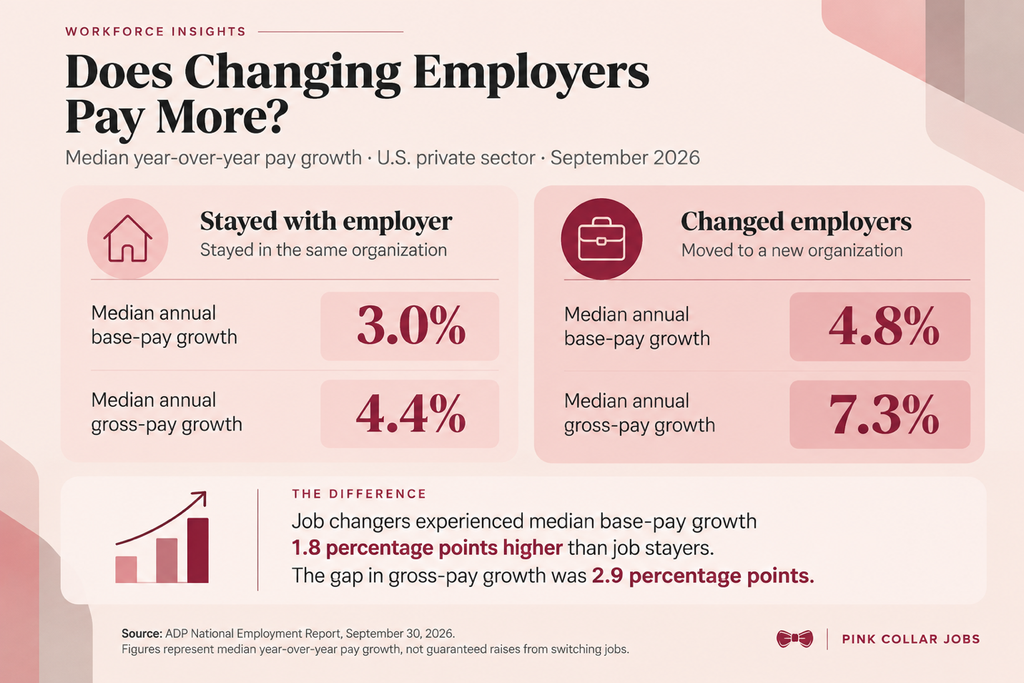
According to ADP’s September 2026 National Employment Report, workers who changed employers experienced higher median annual base-pay growth than those who stayed.
The Pay Difference: Staying vs. Switching Jobs
The numbers help explain why workers may look outside their current organizations rather than wait for their compensation to catch up with the external labor market.
Employers typically manage internal compensation through established salary structures, annual review cycles, and available promotion budgets. External hiring, however, can require organizations to compete with other employers for qualified workers.
Those two compensation processes do not always produce the same results.
An existing employee may receive a modest annual increase while an outside candidate with comparable experience is offered substantially more to fill a similar position.
From the worker’s perspective, the decision to explore outside opportunities may be less about loyalty and more about economics.
Of course, switching jobs does not guarantee a raise. Compensation varies by occupation, location, employer, economic conditions, and individual qualifications. The opportunity to improve pay must also be weighed against what a worker could lose by leaving.
Career Advancement Doesn’t Always Mean Moving Up
The traditional career ladder assumes that professional growth occurs primarily through promotions within a recognizable hierarchy.
Yet many valuable career moves don’t involve an immediate promotion.
A nurse might transition into healthcare administration. A teacher might move into corporate training. A hospitality professional might pursue client relations, while an administrative specialist might develop a career in operations management.
Each move can create opportunities to acquire additional experience, technical knowledge, industry exposure, and professional relationships.
In some cases, the new position may offer similar compensation initially but provide a better foundation for future advancement.
This is where the lily-padding concept becomes especially useful.
A lateral move is not necessarily a stagnant move.
The more important question is whether the next position expands a worker’s options.
And for workers whose experience is built around communication, organization, service, and interpersonal relationships, those options may be considerably broader than their current job titles suggest.
The Transferable Skills That Make Career Mobility Possible
One reason lily-padding can work is that many of the skills employers need aren’t exclusive to a particular occupation or industry.
This is particularly relevant to pink collar work.
Across healthcare, education, administration, hospitality, creative services, community organizations, personal services, retail, digital support, and environmental care, workers routinely develop capabilities that extend beyond their immediate job responsibilities.
Communication. Organization. Adaptability. Conflict resolution. Relationship management. Problem-solving. Emotional intelligence.
These are often described as soft skills, but there is nothing secondary about their importance.
They are professional competencies that help organizations function, relationships succeed, and services reach the people who need them.
And they are often highly transferable.
How Pink Collar Skills Can Open New Career Pathways
Consider how experience developed across the ten core pink collar sectors might translate into different professional opportunities.
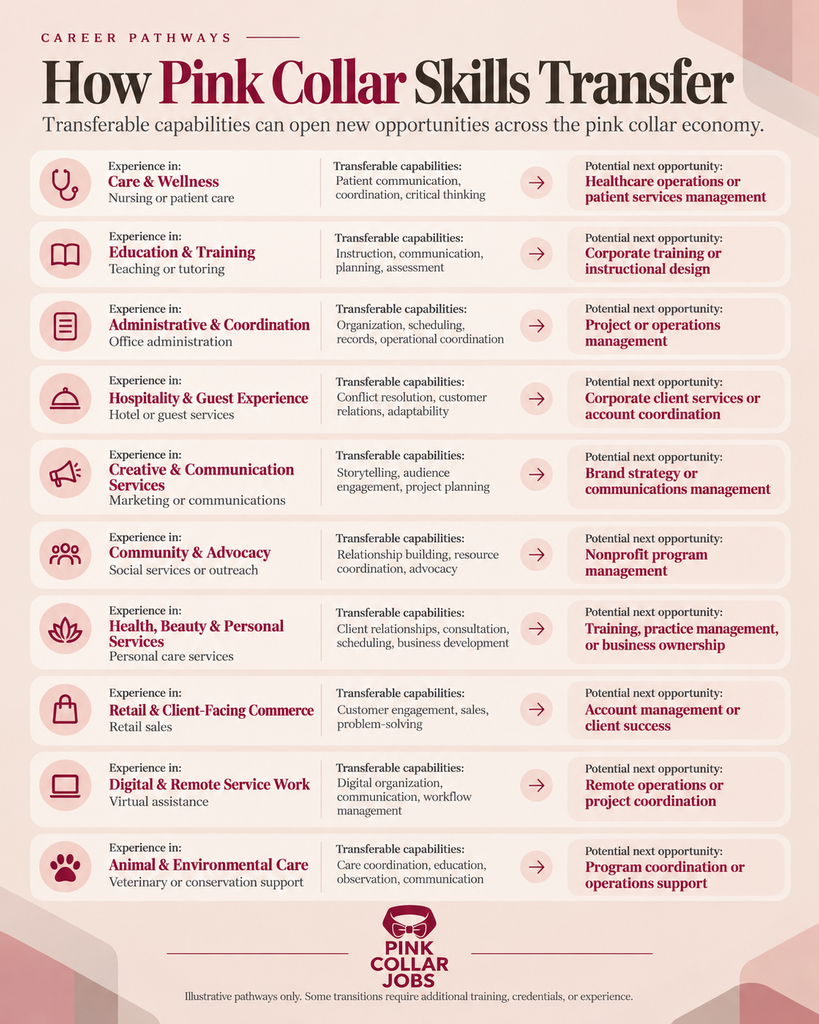
What makes these capabilities valuable is their portability.
Someone who has spent years resolving customer concerns has developed communication and problem-solving skills that may be useful in healthcare, financial services, hospitality, or business operations.
An experienced teacher may possess instructional and interpersonal capabilities that translate well into employee training, organizational development, or educational program management.
A personal services professional who has built a loyal client base may have developed considerable expertise in relationship management, scheduling, business operations, and customer retention.
A veterinary professional may combine technical knowledge with communication, documentation, and coordination skills applicable to a variety of animal care organizations and related services.
The job titles may change, but the underlying competencies remain relevant.
This doesn’t mean workers can move freely between every occupation. Many careers require specific credentials, technical preparation, or supervised experience that transferable skills alone cannot replace.
But it does mean that changing industries doesn’t always require starting from zero.
For workers considering a career transition, this changes the question from “What other jobs have I already done?” to “What have I learned to do well, and where else is that valuable?”
That distinction can open career pathways that might otherwise go unexplored.
The value of a worker’s experience isn’t necessarily limited to the industry in which it was acquired.
The Advantages of Strategic Job Mobility
Changing employers can offer advantages beyond an immediate salary increase.
Greater earning potential. Workers may find that competing organizations place a higher market value on their existing experience and capabilities.
Access to new skills. Moving into different environments can expose workers to technology, operational systems, clients, and responsibilities unavailable in their current positions.
More negotiating leverage. External opportunities can allow workers to evaluate compensation, benefits, schedules, and working conditions rather than relying exclusively on existing employer policies.
Broader career options. Experience gained across multiple organizations or industries may create pathways that would not have emerged within a single employer.
Better professional alignment. A new opportunity may offer more meaningful work, better management, improved work-life balance, or a more sustainable schedule.
Not every advantage can be measured in salary.
Research published by the Federal Reserve in 2024 found that workers evaluating job changes placed substantial importance on their interest in the work, while work-life balance was particularly important for parents.
A separate Federal Reserve report found that 62% of people who changed jobs in 2024 considered their new position better overall, although that percentage had declined from 72% in 2022.
These findings reinforce an important distinction: A better job and a higher-paying job are not necessarily the same thing.
A position offering slightly less pay but significantly better working conditions may represent a meaningful improvement in someone’s overall quality of life.
The Risks Workers Should Consider
Lily-padding can be financially and professionally beneficial. It can also become counterproductive when every move is evaluated primarily by its immediate reward.
Frequent transitions can introduce risks that are easy to overlook.
Starting over repeatedly. New employers come with different expectations, systems, relationships, and organizational cultures. Constant transitions can create stress and reduce opportunities to develop deeper expertise.
Losing accumulated benefits. Changing organizations may affect retirement contributions, vesting, paid leave, insurance coverage, and other benefits tied to tenure.
Limited evidence of accomplishment. Some professional achievements require time. Workers who leave positions before completing significant projects or developing measurable results may struggle to demonstrate the full value of their experience.
Uncertainty about employer stability. A higher salary does not necessarily mean a more secure position. New hires can be exposed to restructuring, budget cuts, probationary periods, or organizational changes.
Questions from future employers. Although multiple job changes are common in contemporary careers, some employers still examine short tenures closely. Workers may need to explain how their transitions contributed to their professional development.
The distinction is not simply between staying and leaving.
It’s between movement that creates long-term value and movement that does not.
When Staying Can Be the Better Decision
The financial case for changing employers is compelling in some circumstances, but remaining with an organization can also produce substantial benefits.
A supportive employer may provide mentorship, internal mobility, advanced training, leadership opportunities, and a clear route toward greater responsibility.
Staying may also allow workers to build professional credibility, complete important projects, accumulate benefits, and establish relationships that strengthen their future career prospects.
In a weaker hiring market, the stability of an existing position can become particularly valuable.
Not every career grows faster through frequent movement. Some professions reward accumulated institutional knowledge, established client relationships, specialized expertise, or long-term professional development.
The best decision depends on what a worker stands to gain and what they would be giving up.
A higher salary is only one part of that calculation.
How to Lily-Pad Without Losing Career Direction
For workers considering a move, the most useful question isn’t simply whether another employer will pay more.
It’s whether the opportunity improves their overall professional position.
Before making a transition, consider:
- Compensation: Does the increase in take-home pay justify changes in benefits, commuting costs, and other expenses?
- Skill development: Will the new role create experience or expertise that improves future employability?
- Career mobility: Does this position open additional pathways, or does it lead toward another occupational dead end?
- Working conditions: How do scheduling, management, workload, and organizational stability compare?
- Transferable experience: Which existing skills make this transition realistic, and what additional qualifications might be necessary?
- Long-term value: Will the move make sense as part of a professional history, even if the next transition takes several years?
A strategic career move should improve more than a job title.
Ideally, it should increase earning power, strengthen transferable skills, expand future choices, or improve the sustainability of working life.
And sometimes, the smartest next move isn’t into a higher position. It’s into a field that offers better prospects for the future.
A Career Is Bigger Than Any One Employer
The traditional career ladder remains a legitimate path. Some workers will find meaningful, financially rewarding careers within a single organization.
Others will build successful careers across several employers, occupations, or industries.
Neither approach is automatically superior.
The important shift is recognizing that professional progress and organizational tenure are not the same thing.
Workers can demonstrate commitment to their careers without committing indefinitely to a particular employer.
And employers that want to retain skilled employees must recognize that their workers have options. Competitive compensation, meaningful advancement, effective leadership, and good working conditions all influence whether staying is worthwhile.
For workers whose experience is built around human interaction, organization, coordination, specialized services, and care, those options may be broader than their current job titles suggest.
The skills developed in one workplace don’t disappear when someone moves to another. They can become the foundation for an entirely new professional direction.
Ultimately, lily-padding is not about changing jobs as often as possible.
It’s about recognizing that career growth doesn’t always require moving up. Sometimes it means recognizing where your existing skills can take you next.
The goal isn’t movement for its own sake.
The goal is progress.
Sources & Further Reading
- ADP Research (September 30, 2026). ADP National Employment Report. National job-changer and job-stayer base-pay and gross-pay growth statistics. ADP Report
- Federal Reserve Board (2024). Katherine Lim and Mike Zabek, What Makes a Job Better? Survey Evidence from Job Changers. Research examining how pay, benefits, job satisfaction, and work-life balance influence workers’ assessments of job changes. Federal Reserve Research
- Federal Reserve Board (May 2025). Economic Well-Being of U.S. Households in 2024 — Job Quality. Data on how workers evaluate employment changes and improvements in working conditions. Federal Reserve Report
- U.S. Bureau of Labor Statistics (September 24, 2026). Employee Tenure in 2026. National data on length of employment with current employers, including a median tenure of 4.1 years in January 2026. BLS Report